



Stress in Europe and Ukraine: Young People’s Perceptions of Life

How stressed are Europe’s and Ukraine’s young, economically active urban populations today — and what shapes their views on life and work? Gradus Research surveyed employed residents aged 25–35 in five of Europe’s largest economies by nominal GDP — the United Kingdom, Germany, France, Italy and the Netherlands — as well as in Ukraine, which has been living under the conditions of a full-scale war with Russia for nearly four years, to understand the levels and sources of stress in their everyday lives.
Stress and burnout: clear gender and country gaps
Across all five countries, women report higher stress and workplace burnout, while men are twice as likely as women to describe their overall level of stress as low (17% vs.8%). A moderate level of stress is reported by 44% of respondents regardless of gender.
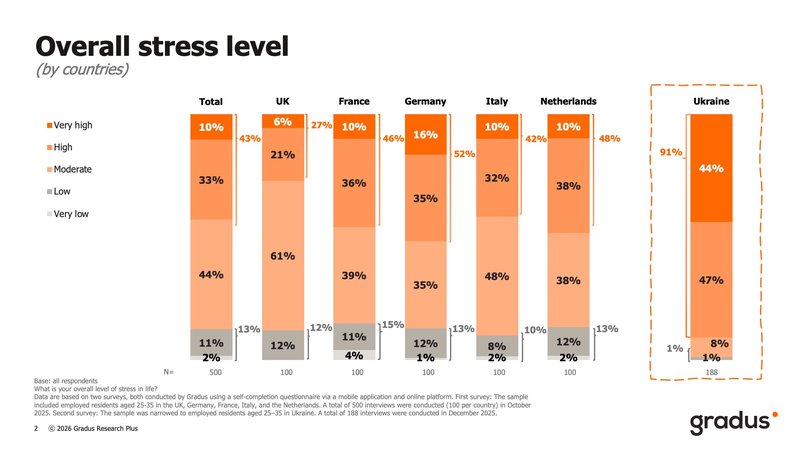
The UK emerges as the least stressed country in the sample, with only 27% of respondents reporting high stress levels, compared with 51% in Germany and 41–48% across other European countries. British respondents are also the most likely to describe their stress as moderate (60%). Ukraine presents a stark contrast: 91% of respondents report high stress levels, including 44% who describe them as very high, reflecting the sustained impact of full-scale war conditions.
Work-related stress follows a broadly similar pattern across countries. High levels are reported by 32% of respondents in the UK and 34% in the Netherlands, compared with 45–46% in Germany, France and Italy. In Ukraine, job-related issues are cited as a major source of stress by 45% of respondents — broadly in line with EU levels — while financial concerns affect 43%, underscoring the combined economic and security pressures facing the population.
Thoughts of quitting a job due to burnout are widespread: 42% of respondents say they have considered leaving their current job at least once for this reason. Women report such thoughts more often than men (46% vs. 36%). The UK again stands apart, with only 25% having considered quitting, compared with roughly half of respondents in France and Italy and 43% in Germany and the Netherlands.
Fatigue and lack of time are the main stressors
Overall, emotional burnout is reported by 18% of men and 24% of women. The lowest levels are observed in the UK (11%) and the Netherlands (19%), while Germany, France, and Italy cluster at 24–26%.
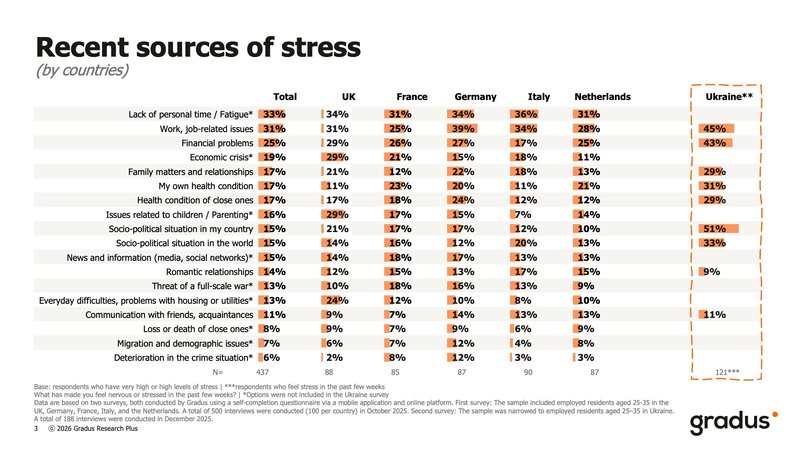
Asked about the main sources of recent stress, respondents most often cite lack of personal time and fatigue (33%), followed by work-related issues (31%). Women are significantly more likely to report stress linked to fatigue and lack of time for themselves (39% vs. 27% of men). Migration and demographic issues (7%) and concerns about crime (5%) are the least frequently mentioned stressors.
Economic anxiety varies sharply by country. In the UK, 28% report stress related to the economic crisis, compared with just 11% in the Netherlands. The UK also shows the highest share of respondents stressed by issues related to raising children (28%), while in Italy this figure stands at 7%. Health-related stress is most common in France (22%), followed by Germany and the Netherlands (20% each), and is notably lower in the UK and Italy (11% each).
“The survey highlights the emotional state and key sources of stress among young Europeans and Ukrainians who are actively building their careers and personal lives while closely following political and economic developments,” says Evgeniya Blyznyuk, sociologist and CEO and founder of Gradus. “Respondents in the UK consistently report lower stress and higher self-assessments of well-being. In EU countries, Germany and the Netherlands show more moderate evaluations, while France and Italy display more polarised responses, likely reflecting cultural factors and differences in income distribution and social support. By contrast, young Ukrainians report notably higher stress levels, driven by the ongoing war, security concerns, and deep uncertainty about future prospects.”
Data are based on two surveys, both conducted by Gradus using a self-completion questionnaire via a mobile application and online platform. First survey: The sample included employed residents aged 25-35 in the UK, Germany, France, Italy, and the Netherlands. A total of 500 interviews were conducted (100 per country) in October 2025. Second survey: The sample was narrowed to employed residents aged 25–35 in Ukraine. A total of 188 interviews were conducted in December 2025.
Other reports
-
 Stress in Europe and Ukraine: Young People’s Perceptions of LifeFebruary 2026International survey on the emotional state of young people, sources of stress, and attitudes toward work and life
 -
 Most Ukrainians are staying home despite blackoutsJanuary 2026Special survey on the impact of blackouts on Ukrainians' migration attitudes
 -
 What Ukrainians hope for in 2026 and how the war is changing holiday traditionsJanuary 2026What are Ukrainians hoping for in 2026, and how is the war changing holiday traditions in Ukraine?
 -
 Wartime survey of Ukrainian society / thirteenth waveDecember 2025Ukrainians Seek a Sustainable Peace and Do Not Believe in a Quick End to the War